Showing posts with label medical. Show all posts

Aug 7, 2011

Five Free And Simple Google Tools For Medical Practitioners

Google is the biggest influence on the web over the past 20 years of the internet. Their “Do No Evil” ‘philosophy’ has given us a whole stable of free and easy to use tools which can make any work easier and better. All of us use the Google Search Engine Homepage everyday! There is lots more a doctor can do with Google tools. Let’s take a look at Five Free And Simple Google Tools For Medical Practitioners.

1) Gmail
This is the most useful service ever by Google, barring Google Search. And you can have more of it! You can use Gmail to create 2 (or more) free accounts. So you can create one personal and another public email address for your medical practice. Eg: one can be dr.abc@gmail.com and another neuromumbai911@gmail.com. By going to settings, you can then set to import your other email account into your primary gmail account. You can enable ‘multiple inboxes’ via Labs subtab, allowing you to receive neatly segmented mails. Check this video.
.
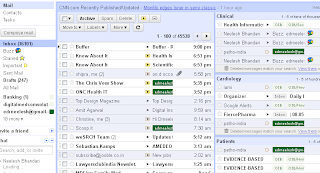
You can reply by your choice of account, enabling you to keep your personal and professional emails separated by different accounts, yet accessible and answerable from one single account.

Here’s a detailed screenshot enhanced post about this feature on Make Tech easier.

If there are certain terms you want to follow on Google and receive any new mentions directly to your email inbox, create a Google Alert. Fill in the term you need to follow, like ‘Cardiology India news’ or ‘neelesh bhandari’ and set the frequency/type of alerts required. Stay updated via email.

Maps and Places allow you to mark your professional locations and timings on a map. Link this marked map within all your emails. Henceforth all patients you email will see how to reach you easily via a map, with additional info about consultation hours that you might want to share.

You don’t need to always go to Pubmed for all your medical searches. Head to Google Scholar and do any advanced search (author, type, publication year and lots more filters). You will get More Results. You will search more medical databases. Try it.

Online videos are the most important medical info resource. But you don’t need to create videos to run a medical educational channel for your patients. Just create a channel by free login and start marking as favorite the best medical education videos you think might help your patients. Set channel settings to demonstrate your video favorites. Thus, you have a full blown video channel. Zero cost!

We are planning another post on 5 Advanced And Free Google tools For Medical Practitioners. If you want to read that soon, Share This.

If you need help with any of the above 5 tools, comment below.


(cross-posted on Technology For Doctors )

Aug 6, 2011

5 Useful and Free Android Medical Apps


Use of Smartphones in healthcare is the latest intersection of Technology and Medicine. These inexpensive handheld computing devices allow users to download third party applications (apps) which can perform specialized tasks. Most Smartphones run on either the Apple iPhone’s iOS or the Android OS and there are literally tens of thousands of medical apps available for either of these operating systems.

Clinical care is information intensive and some of the most commonly used mobile applications by physicians are for medical reference. By providing the latest evidence based medicine updates at the point-of-care, Smartphones are proving to be a very important tool for improving quality of healthcare.Here's a list of Top 5 Free Medical Reference Apps For Android Smartphones which physicians can use everyday for clinical purposes.

1) Medscape : Medscape is a popular web resource for physicians and other health professionals. This is a must have application which provides offline access to clinical reference tools like Drug Reference, Disease & Condition Reference and Treatment Guide, Procedures Reference, Tables & Protocols Reference and Drug Interaction Checker.

2) Skyscape Medical Resources : Founded by a group of Indian innovators, Skyscape is a worldwide leading service for providing trusted medical information via mobile devices. The Skyscape portal provides a number of free as well as paid medical apps for almost all specialties.

3) Epocrates : Epocrates is a publisher of mobile device software applications, designed to provide information about drugs to doctors and other health care professionals. The Epocrates application is the most popular of its kind providing a huge amount of information about pharmaceuticals. Regular use of this app can definitely help reduce errors in drug prescriptions.

4) PubMed Mobile : An uber useful app by the National Library of Medicine, PubMed Mobile allows the user to search its database with over 21 million citations for articles and journals, save articles and searches, view abstracts, and export selected abstracts and citations for future use. NLM also provides a number of other mobile optimized tools and apps. Check the NLM Mobile Gallery here.

5) WebMD : WebMD is the leading health information portal of the United States. It was founded in 1996 by Jim Clark and Pavan Nigam as Healthscape, later Healtheon, and then acquired WebMD in 1999 to form Healtheon/WebMD. The free app provides access to information regarding health and health care, including a symptom checklist, pharmacy information and drugs information.

This article has been cross-posted on Technology For Doctors blog.

Dec 10, 2010

Social Media and a Medical Practitioner: Guide from 'Down Under'


Facebook logo


Research Projects like those carried out by pathoftheblueeye.com as well as by Accenture have pointed out Medscape.com and WebMD.com as the most often visited sites by Medical Professionals ( 50 % of the time spent within health category) as well as non-medicos. Social Media sites showed  a rapidly rising 6% of time spent by a large number of people.

Social Media is now being widely used by doctors as well as patients. All doctors even remotely on social media face many ethical and moral questions regarding online physician-patient relationships. So when is it Okay to use social media and when is it Not ?!

Recently, The American Medical association posted some guidelines for Doctors use of social media tools in a professional capacity.

But now we have the Australia Medical Association and New Zealand Medical Association come out with their version on this dilemma. Here is the google document ( a 14 page pdf you can download/ view online). It is one of the most practical and useful guide of its kind online.

Dec 9, 2010

Which Healthcare Workers get Assaulted the Most on-duty?

Healthcare workers get assaulted 4 times more often than any other sector!
Amplify’d from blogs.wsj.com
They looked at government stats and found that while shootings in health-care workplaces are pretty rare, the rate of assaults is relatively high — 8 per 10,000 workers vs. 2 per 10,000 for all private-sector industries. Nursing staff in nursing homes or long-term care facilities, ICUs, psych units and emergency departments are at higher risk, the paper says.

The authors — Gabor Kelen and Christina Catlett, both from Hopkins’s emergency medicine department and its office of critical event preparedness and response — cite a couple of factors that may be behind the higher-than-average assault rate. Among them: physicians are no longer “viewed with reverence,” health-care is increasingly viewed as a business and patients are often frustrated in their dealings with the system. At the same time “societal incivility may have reached new lows,” with some people turning to violence.Read more at blogs.wsj.com

Dec 30, 2008

Three Points about Medical Informatics in India.


As knowledge expands and requires better management, role of I.T in health care can only become more important. India has a large number of trained I.T professionals and is in a position to leverage its Brain power to take Health informatics to new heights. As i have argued before, smart use of health informatics can also help us attain Health rights for all in many ways (lower costs, better quality, better informed patients, e.t.c). Here, i have tried to showcase a few points about Use of Health Informatics in India as well as the various educational courses available within India.

The Three major uses of Health informatics in India
1) For better training of Health care professionals ( includes Doctors, Paramedicals and Non-medicals)- e.learning
2) For improved delivery of high quality health care services to the remote areas.- Telemedicine,EMRs, CDSS.
3) To bring about a transparency in public health care delivery system.(e-governance)- Public participation

The three major obstacles to Health Informatics in India.
1) Inadequate Skills of health care personnel/others
2) Inadequate Physical infrastructure
3) Inadequate access to I.T ( Digital divide).

The Three major Post Graduate Health care Informatics courses in India
1) Medvarsity online P.G Diploma in Medical Informatics. , associated with Apollo group of Hospitals
2) Amrita Institute of Medical sciences MSc/ P.G.Diploma in Medical Informatics , at Kochi,India.
3) Post Graduate Programs at BII (Bioinformatics Institute of India), Noida, with good industry integration.

The Three short Online courses for Medical Informatics in India-
1) eHCF School of Medical Informatics, Delhi provides Certificate course in medical informatics
2) IAHI online course on Health Informatics
3) BII provides various online/distance educations courses in Health care Informatics.

In view of the fast changing world of medical informatics, it is essential to formulate a flexible syllabus rather than a rigid one for incorporating into the regular curriculum of medical and paramedical education. Only after that one may expect all members of the health care delivery systems to adopt and apply medical informatics optimally as a routine tool for their services.
Suptendra Nath Sarbadhikari


Reblog this post [with Zemanta]

Three Points about Medical Informatics in India.


As knowledge expands and requires better management, role of I.T in health care can only become more important. India has a large number of trained I.T professionals and is in a position to leverage its Brain power to take Health informatics to new heights. As i have argued before, smart use of health informatics can also help us attain Health rights for all in many ways (lower costs, better quality, better informed patients, e.t.c). Here, i have tried to showcase a few points about Use of Health Informatics in India as well as the various educational courses available within India.

The Three major uses of Health informatics in India
1) For better training of Health care professionals ( includes Doctors, Paramedicals and Non-medicals)- e.learning
2) For improved delivery of high quality health care services to the remote areas.- Telemedicine,EMRs, CDSS.
3) To bring about a transparency in public health care delivery system.(e-governance)- Public participation

The three major obstacles to Health Informatics in India.
1) Inadequate Skills of health care personnel/others
2) Inadequate Physical infrastructure
3) Inadequate access to I.T ( Digital divide).

The Three major Post Graduate Health care Informatics courses in India
1) Medvarsity online P.G Diploma in Medical Informatics. , associated with Apollo group of Hospitals
2) Amrita Institute of Medical sciences MSc/ P.G.Diploma in Medical Informatics , at Kochi,India.
3) Post Graduate Programs at BII (Bioinformatics Institute of India), Noida, with good industry integration.

The Three short Online courses for Medical Informatics in India-
1) eHCF School of Medical Informatics, Delhi provides Certificate course in medical informatics
2) IAHI online course on Health Informatics
3) BII provides various online/distance educations courses in Health care Informatics.

In view of the fast changing world of medical informatics, it is essential to formulate a flexible syllabus rather than a rigid one for incorporating into the regular curriculum of medical and paramedical education. Only after that one may expect all members of the health care delivery systems to adopt and apply medical informatics optimally as a routine tool for their services.
Suptendra Nath Sarbadhikari


Oct 22, 2008

- Imaging techniques in Pathology-

Israel's ASI gives pathologists a vital second opinion - ISRAEL21c

-I have written previously about the subjectivity involved in the practise of Pathology. Its difficult to get two pathologists to agree on any one diagnosis if both pathologists insist on looking at the case through the prism of their own experiences.Besides, it is always tough disputing any one"s diagnosis as it is merely an opinion and reflects the Pathologists own "view" of the case.

Now, ASI (Applied Spectral Imaging), a privately held company in Israel has come up with a colorful solution for the problem. Instead of depending totally on the "morphology", ie shape and size, it provides a way to visualize the antigenic proteins present in the tissue. Using their Spectracube family of products, It allows researchers to distinguish between
different materials on a chromosome by highlighting its features with
unique colors, instead of the black dye that had been used previously. This leads to better identification in suspicious cases and the test also lends itself to reproducibility.

The company has already launched " TB Finder" in the market.In addition to TB Finder, ASI is already selling
or planning to market additional tools for pathologists, including
PathEx, as well as for morphologists, who examine protein structures
and alterations in cell structures.


The company presently promotes its products only as a backup / second opinion. But this seems to be more out of its desire not to rub the so-called "Specialists" the wrong way. Being able to corroborate one"s opinion by a scientific and a reproducible test is a tool sorely needed in the practise of Pathology. I shall not be surprised if such corroboration of opinion of a pathologist soon becomes a norm rather than an option.

All in all, a very very useful service to improve accuracy of diagnosis.

- Imaging techniques in Pathology-

Israel's ASI gives pathologists a vital second opinion - ISRAEL21c

-I have written previously about the subjectivity involved in the practise of Pathology. Its difficult to get two pathologists to agree on any one diagnosis if both pathologists insist on looking at the case through the prism of their own experiences.Besides, it is always tough disputing any one"s diagnosis as it is merely an opinion and reflects the Pathologists own "view" of the case.

Now, ASI (Applied Spectral Imaging), a privately held company in Israel has come up with a colorful solution for the problem. Instead of depending totally on the "morphology", ie shape and size, it provides a way to visualize the antigenic proteins present in the tissue. Using their Spectracube family of products, It allows researchers to distinguish between
different materials on a chromosome by highlighting its features with
unique colors, instead of the black dye that had been used previously. This leads to better identification in suspicious cases and the test also lends itself to reproducibility.

The company has already launched " TB Finder" in the market.In addition to TB Finder, ASI is already selling
or planning to market additional tools for pathologists, including
PathEx, as well as for morphologists, who examine protein structures
and alterations in cell structures.


The company presently promotes its products only as a backup / second opinion. But this seems to be more out of its desire not to rub the so-called "Specialists" the wrong way. Being able to corroborate one"s opinion by a scientific and a reproducible test is a tool sorely needed in the practise of Pathology. I shall not be surprised if such corroboration of opinion of a pathologist soon becomes a norm rather than an option.

All in all, a very very useful service to improve accuracy of diagnosis.

Oct 19, 2008

- Telepathology made simple-

MEDTING - MedicalTube, medical meeting; exchange video and image


As a pathologist, I know the importance of collaboration and second opinions. The practice of pathology is sometimes very subjective and its not unusual to get three different diagnosis for the same tissue sample/ histopatholgy slide from three different pathologists.Besides, all pathologists at one institute tend to think along similar lines, further increasing chances of bias. But getting distant doctors to review any one case and histopathology slide has been difficult till date. The best we could do was "store-and-forward" telepathology, where the images of a histopathology slide were forwarded to known experts via email for second opinion. A very primitive means of practicing telepathology, if i may say so!


Enter Medting.


"MEDTING is a clinical web portal that provides a platform for exchanging clinical cases, images, and videos. Physicians can post clinical cases with associated images or videos for discussion among colleagues. In addition, independent images or videos can be sent to the Atlas space for other to review. Other members of the community can then vote and write comments on the cases and images posted."


Medting allows doctors from around the globe to offer their opinions on any histopathology slide (or any other clinical image). Any doctor can upload the facts and images related to any case for second opinions from experts all over the globe.Patient privacy is not compromised as names are not revealed and the site claims to be 100% HIPAA compliant.


The images uploaded presently on the site were of very good resolution. One could easily scan the whole slide, Zoom in on interesting areas of the slide, leave comments, tag images, share them, etc. It provides an excellent collaboration platform and can serve as an excellent educational tool. At present, it boasts of 1840 cases and 15760 images and videos. Cases and images are tagged with keywords using the SNOMED CT terminology.


Medting also offers premium membership and individual institutional support.


I like their service, though it is still very BASIC and has tremendous scope for improvement.


Related articles


=

- Telepathology made simple-

MEDTING - MedicalTube, medical meeting; exchange video and image

As a pathologist, I know the importance of collaboration and second opinions. The practice of pathology is sometimes very subjective and its not unusual to get three different diagnosis for the same tissue sample/ histopatholgy slide from three different pathologists.Besides, all pathologists at one institute tend to think along similar lines, further increasing chances of bias. But getting distant doctors to review any one case and histopathology slide has been difficult till date. The best we could do was "store-and-forward" telepathology, where the images of a histopathology slide were forwarded to known experts via email for second opinion. A very primitive means of practicing telepathology, if i may say so!

Enter Medting.

"MEDTING is a clinical web portal that provides a platform for
exchanging clinical cases, images, and videos. Physicians can post
clinical cases with associated images or videos for discussion among
colleagues. In addition, independent images or videos can be sent to
the Atlas space for other to review. Other members of the community can
then vote and write comments on the cases and images posted
."

Medting allows doctors from around the globe to offer their opinions on any histopathology slide (or any other clinical image). Any doctor can upload the facts and images related to any case for second opinions from experts all over the globe.Patient privacy is not compromised as names are not revealed and the site claims to be 100% HIPAA compliant.

The images uploaded presently on the site were of very good resolution. One could easily scan the whole slide, Zoom in on interesting areas of the slide, leave comments, tag images, share them, etc. It provides an excellent collaboration platform and can serve as an excellent educational tool. At present, it boasts of 1840 cases and 15760 images and videos. Cases and images are tagged with keywords using the SNOMED CT terminology.

Medting also offers premium membership and individual institutional support.

I like their service, though it is still very BASIC and has tremendous scope for improvement.

Oct 15, 2008

-Characterstics of a medical blogger-

Examining the Medical Blogosphere: An Online Survey of Medical Bloggers | Kovic | Journal of Medical Internet Research
Blogs are the major contributors to the
large increase of new websites created each year. Most blogs allow
readers to leave comments and, in this way, generate both conversation
and encourage collaboration. Despite their popularity, however, little
is known about blogs or their creators.
This was a study on 197 medical bloggers, their backgrounds, blogging habits, reasons for blogging, etc.
Majority of medical bloggers were highly educated, white, American males, between the ages of 30 and 49 years.Almost half of them had a personal website before they started blogging. Most had been blogging for more than two years. More males offered news via RSS than female bloggers.

Major motivations for blogging were sharing practical knowledge or skills with others, influencing the way other people think, and expressing oneself creatively. Making money and staying in touch with friends and family were not reasons to blog for a majority of the participants.
All in all, a very informative study.
Read it here.

Health wisdom , not just information

I am always on the look out for web services delivering knowledge services in the field of health. I run a non-profit organization, RAKSHA, for exactly this purpose and seek new ways of achieving democratization of knowledge in health.

Organized wisdom is a well thought out web service. This interview with the team at Organized wisdom clearly spells out their views and visions for this knowledge service. The talk with their Chief Medical Officer, Dr. Howard Krein and Esther Dyson , one of the investors was very interesting.


The service claims to be " a free service that provides patients with easy access to the best information available in easy to navigate Wisdomcards, helps patients to prepare for their appointments and helps streamline some to the conversations that must take place."
So, I decided to explore this service logged in as a patient searching for information about my imaginary headache. The first thing i noticed was the cleanliness of the welcome page. Simple, no unnecessary multimedia ( as is VERY often the case with medical information sites) and therefore, fast navigation between pages.

The fonts were friendly, the letters bold and easily legible. It didn't intimidate me, as a patient, with its vastness of information. There was a large search box in a major location with built in prompts via a drop down menu. So far so good.

What really won me over was the neatly laid out information. Not too deep on the first page, just plain English medical speak for an average person.There were links to more scholarly items, but everything i could possibly want to know as a patient was easily available within 2 degrees of separation. There were links to support forums, foundations and drug information ( again in plain English).There were chat rooms, message boards, personal blogs, every useful service i can think of today. They were also initiating a" LIVE chat with a doctor" service, which is now in a beta phase.

All in all, I really liked this service and i am sure something like this will soon be up and running in India, preferably in the Hindi language.
Amen.

Health wisdom , not just information

I am always on the look out for web services delivering knowledge services in the field of health. I run a non-profit organization, RAKSHA, for exactly this purpose and seek new ways of achieving democratization of knowledge in health.

Organized wisdom is a well thought out web service. This interview with the team at Organized wisdom clearly spells out their views and visions for this knowledge service. The talk with their Chief Medical Officer, Dr. Howard Krein and Esther Dyson , one of the investors was very interesting.


The service claims to be " a free service that provides patients with easy access to the best information available in easy to navigate Wisdomcards, helps patients to prepare for their appointments and helps streamline some to the conversations that must take place."
So, I decided to explore this service logged in as a patient searching for information about my imaginary headache. The first thing i noticed was the cleanliness of the welcome page. Simple, no unnecessary multimedia ( as is VERY often the case with medical information sites) and therefore, fast navigation between pages.

The fonts were friendly, the letters bold and easily legible. It didn't intimidate me, as a patient, with its vastness of information. There was a large search box in a major location with built in prompts via a drop down menu. So far so good.

What really won me over was the neatly laid out information. Not too deep on the first page, just plain English medical speak for an average person.There were links to more scholarly items, but everything i could possibly want to know as a patient was easily available within 2 degrees of separation. There were links to support forums, foundations and drug information ( again in plain English).There were chat rooms, message boards, personal blogs, every useful service i can think of today. They were also initiating a" LIVE chat with a doctor" service, which is now in a beta phase.

All in all, I really liked this service and i am sure something like this will soon be up and running in India, preferably in the Hindi language.
Amen.

Oct 7, 2008

An open letter to the Physicians of the world

Open Letter to the Physicians of the World « ScienceRoll


I am attaching a link to an open letter published on the internet.


That we doctors need to use Web 2.0 applications to ease our burden and improve the quality of our work is given. I have never come across any colleague or senior who disputes the usefulness or necessity of using these applications.


The biggest hurdle is achieving relevant computer skills. No doctor who wants to continue practicing even for next 5-10 years can shy away from regular use of computers and the internet to ease and improve work. But the inbuilt inertia of our seniors is hard to overcome.I should know that. I had this teacher during my pathology post graduation who didn't allow me to introduce evidence based practices in our department. He insisted that HIS opinion was the final and the best opinion and to think of using information retrieval technology for improving diagnostic skills and education was not encouraged ( Frankly, i would say " actively discouraged". He flunked me in my exams a few times after that, from spite or otherwise).


But i sincerely hope and KNOW that there is a vast majority of doctors out there who require and seek appropriate training in the use of the Internet for medical practice. What is required is a method to tap into this enthusiasm and train all currently practicing doctors in proper use of Web 1.0 and Web 2.0 applications like email lists,blogs, social networks, bookmarking, wikis, medical search engines, instant messaging, podcasts, vodcasts.... the list could go on.


Anyways, read this letter here.

An open letter to the Physicians of the world

Open Letter to the Physicians of the World « ScienceRoll


I am attaching a link to an open letter published on the internet.


That we doctors need to use Web 2.0 applications to ease our burden and improve the quality of our work is given. I have never come across any colleague or senior who disputes the usefulness or necessity of using these applications.


The biggest hurdle is achieving relevant computer skills. No doctor who wants to continue practicing even for next 5-10 years can shy away from regular use of computers and the internet to ease and improve work. But the inbuilt inertia of our seniors is hard to overcome.I should know that. I had this teacher during my pathology post graduation who didn't allow me to introduce evidence based practices in our department. He insisted that HIS opinion was the final and the best opinion and to think of using information retrieval technology for improving diagnostic skills and education was not encouraged ( Frankly, i would say " actively discouraged". He flunked me in my exams a few times after that, from spite or otherwise).


But i sincerely hope and KNOW that there is a vast majority of doctors out there who require and seek appropriate training in the use of the Internet for medical practice. What is required is a method to tap into this enthusiasm and train all currently practicing doctors in proper use of Web 1.0 and Web 2.0 applications like email lists,blogs, social networks, bookmarking, wikis, medical search engines, instant messaging, podcasts, vodcasts.... the list could go on.


Anyways, read this letter here.

Oct 6, 2008

E-learning in Medical education

The use of elearning in medical education: a review of the current situation -- Choules 83 (978): 212 -- Postgraduate Medical Journal

Computers are increasingly used in medical education. Electronic learning (elearning) is moving from textbooks in electronic format (that are increasingly enhanced by the use of multimedia adjuncts) to a truly interactive medium that can be delivered to meet the educational needs of students and postgraduate learners. Computer technology can present reliable, reusable content in a format that is convenient to the learner. It can be used to transcend geographical boundaries and time zones. It is a valuable tool to add to the medical teacher’s toolkit, but like all tools it must be used appropriately. This article endeavours to review the current "state of the art2 in use of elearning and its role in medical education alongside non-electronic methods—a combination that is currently referred to as "blended" learning.

Read the full article on BMJ health intelligence.